The Procrastination Problem Nobody Talks About
It’s not discipline. It’s not laziness. It’s the choosing.
March 23, 2026
You know the feeling.
You’ve got a free hour. Maybe thirty minutes. You could practice guitar. You could read. You could write. You could meditate. You could stretch. You’ve been meaning to do all of them.
You don’t do any of them.
Instead you open your phone, scroll for a while, and the window closes. Later you’ll call it procrastination. You might even call it laziness. You’ll tell yourself you need more discipline. More structure. A better system.
But here’s the thing nobody talks about: you didn’t avoid hard work. You avoided choosing.
The real bottleneck
When you have one obligation — a meeting, a deadline, an appointment — you do it. There’s no decision to make. But when you have five things you care about equally, you freeze. Psychologists call it “choice paralysis.” The more options you have, the harder it is to pick one, and the more likely you are to pick nothing.
This isn’t a productivity problem. It’s a caring problem. It specifically afflicts people who care about many things. The cruelest irony: the more interests you have, the less likely you are to pursue any of them.
Why the usual advice fails
“Just pick one and start.” Easy to say. But picking is the hard part. If you could just pick one, you wouldn’t be stuck.
Prioritization frameworks don’t help either. The Eisenhower matrix. Time blocking. Weekly reviews. These add another layer of decisions on top of the decisions you’re already struggling with. Now you’re not just choosing what to do — you’re choosing which system to use to choose what to do.
Accountability partners can’t help either. They can hold you to a commitment, but they can’t tell you which of your five passions should get today’s thirty minutes.
The problem was never motivation. It was the menu.
A die and a kitchen timer
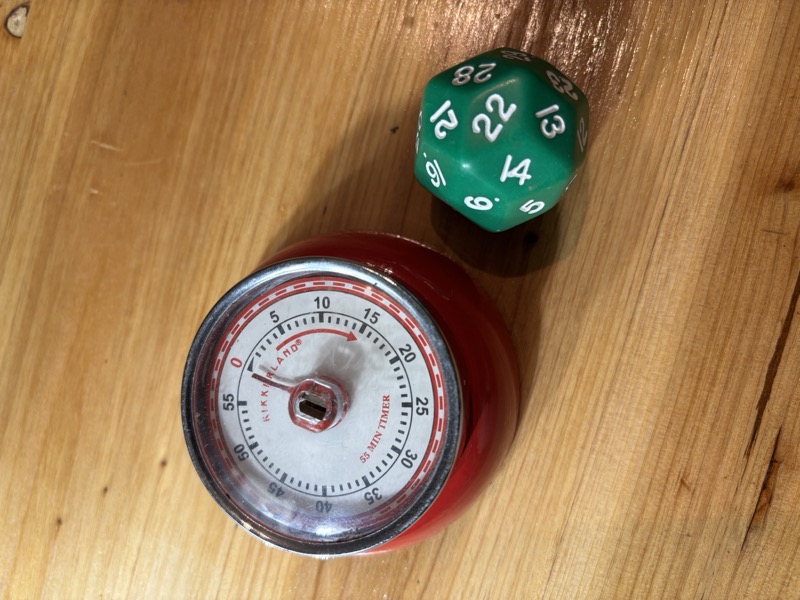
A few years ago I tried something dumb. I had a 30-sided die — left over from a tabletop game — and a kitchen timer. I wrote my activities on a list, numbered them, and rolled the die. Whatever came up, I’d twist the timer to some random number and do that thing until it rang.
It worked. Not because the die was wise, but because it removed the one thing that was stopping me: the decision. I didn’t have to weigh options. I didn’t have to justify why guitar deserved today’s minutes more than reading. The die chose. I just showed up.
And something unexpected happened. The activities I’d been avoiding for weeks started getting done. Not because I was more disciplined. Because they kept coming up. Randomness is fair in a way that planning isn’t — everything gets a turn.
What the die couldn’t do
But the die had limits. It didn’t remember what I rolled yesterday. The kitchen timer didn’t track whether I’d shown up three days in a row or three weeks in a row. There was no score, no streak, no history. Every day started from zero with nothing to show for the day before.
Turns out the hard part wasn’t choosing what to do. It was coming back tomorrow. And the day after that. And the day after that.
That’s what I built hatrack to solve. The randomness stayed — it’s still the core of the whole thing. But now the sessions count. Points for every completed timer. A streak for consecutive days. A history that proves you showed up even on the days it didn’t feel like it.
The die got me started. The app kept me going.
It’s not about the thing you didn’t do
If this sounds familiar, I want you to hear something: you’re not lazy. You’re not broken. You don’t lack discipline. You have the opposite problem — you care about too many things to easily choose between them, and the weight of choosing keeps you from starting.
The fix isn’t to care less. It’s to stop choosing.
Put your activities on the rack. Tap a button. A random hat comes up. A random timer rolls. Do that thing until the chime plays. Tomorrow, something different comes up. Over time, everything gets attention. Nothing falls through the cracks.
No optimizing. No prioritizing. No guilt about what you didn’t pick — it’ll come up next time.